
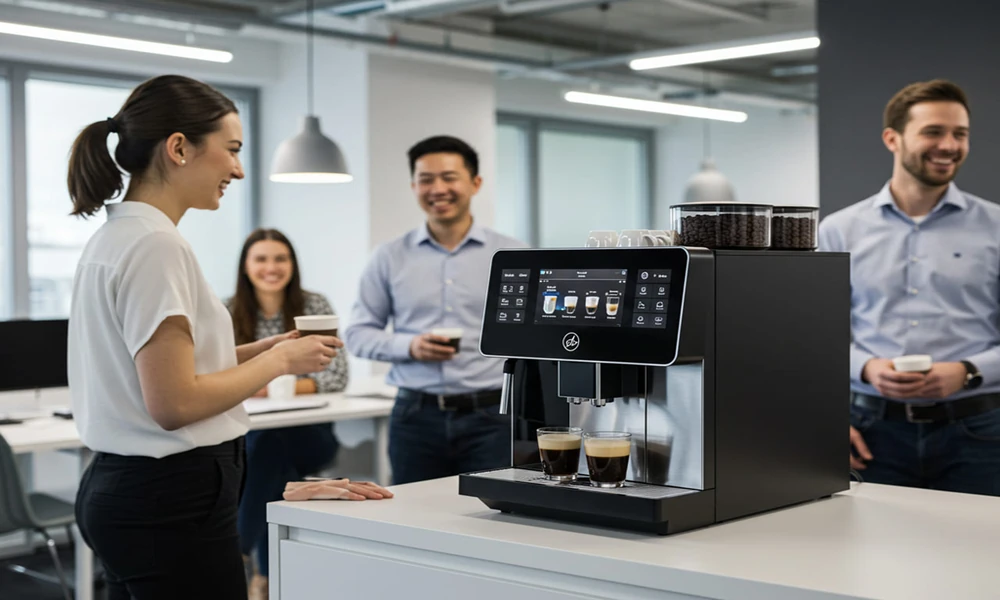
Walk into any pantry supplier’s showroom in Singapore and you’ll find three broad families of coffee machine competing for your attention, and understanding the fundamental mechanics behind bean-to-cup, capsule, and filter systems makes every other decision in the buying or renting process considerably easier.
Bean-to-Cup Machines Explained
A bean-to-cup machine grinds whole beans fresh for each cup, then tamps and extracts using an internal brewing mechanism, which is the same basic principle behind a café espresso machine condensed into a single automated unit. The appeal is straightforward: freshly ground coffee retains far more aromatic complexity than pre-ground alternatives, since grinding exposes the coffee’s oils to oxygen and they begin degrading almost immediately. These machines typically offer the widest range of drink types, from a straightforward espresso through to lattes and cappuccinos, and they suit offices where coffee quality is treated as a genuine priority rather than an afterthought.
Capsule and Pod Systems
Capsule machines trade some flavour complexity for speed, consistency, and minimal cleanup, since each pod is pre-measured and sealed, removing variables like grind size or bean freshness from the equation entirely. For offices juggling a wide range of individual preferences, capsule systems offer an easy way to let each person choose their own blend or roast without needing separate equipment, since switching between a dark roast and a lighter one is as simple as swapping the capsule. The trade-off is generally cost per cup, which tends to run higher than bean-to-cup once you account for the packaging and portioning built into each capsule.
Filter and Batch Brew Machines
Filter machines brew larger volumes at once, which suits environments where people want coffee available continuously through a shift rather than individually prepared cup by cup. This category tends to be the most economical on a per-cup basis and the simplest to maintain, since there’s no grinder or milk system to service. The trade-off is less versatility, since filter coffee doesn’t offer the espresso-based drink range that bean-to-cup or capsule systems provide, and quality can degrade if a pot sits on a hot plate for too long without being refreshed.
Water Quality and Its Effect on Every Machine Type
Regardless of which machine family you choose, water quality plays a bigger role in final taste than most buyers expect. Singapore’s tap water is safe but carries mineral content that affects both taste and how quickly scale builds up inside a machine’s internal components. Many commercial setups pair a machine with an inline filtration system specifically to protect the equipment and improve extraction consistency, and this is worth factoring into your decision alongside the machine itself rather than treating it as a separate afterthought.
Weighing Rental Against Purchase for Any Machine Type
Whichever machine family suits your office, the decision of whether to rent or buy that equipment sits on top of the technical choice and deserves its own consideration, since the answer often differs by machine type. Bean-to-cup machines in particular carry more internal complexity and higher servicing needs, which tends to tilt the calculation toward renting for companies without dedicated facilities support. A good next step once you’ve narrowed down a machine family is browsing what’s actually available through Daiohs, where machine tiers within each category are laid out alongside their service terms.
Making the Final Call
Once you’ve settled on a machine family that fits your office’s coffee culture and worked out roughly how many people it needs to serve, the remaining decision is mostly about capacity and service terms rather than technology itself. It helps to resist the pull toward the most feature-rich option on offer if your actual usage pattern doesn’t justify it, since an overspecified machine brings higher servicing costs without a corresponding benefit for a team that mostly just wants a decent cup between meetings.
Servicing Needs Differ by Machine Family
The technology behind each machine type also determines how much ongoing attention it needs once installed, and this is worth factoring in alongside taste and drink range rather than treating servicing as an identical afterthought across all three families. Bean-to-cup machines carry the most internal complexity, with a grinder, brew group, and often a milk system that all need periodic cleaning and occasional parts replacement, which means they benefit most from a structured maintenance schedule. Capsule machines are mechanically simpler and tend to need less intervention, though the brewing chamber still needs regular cleaning to avoid residue buildup. Filter machines sit at the low-maintenance end of the spectrum, with the main upkeep being the carafe and heating plate rather than any internal grinding or extraction mechanism, which is part of why they remain popular in settings where nobody wants to think about the machine at all.
Trial Periods Are Worth Requesting
Many suppliers in Singapore are open to a trial placement before committing to a longer contract, and this is worth requesting regardless of which machine family looks best on paper, since actual daily use in your specific office often surfaces preferences that a showroom demonstration never reveals. A machine that seemed perfectly adequate during a five-minute test can feel slow once twenty people are queuing for it every morning, or a capsule system that looked convenient in isolation might frustrate a team that actually cares about espresso quality once the novelty wears off. A short trial removes the guesswork and lets the decision rest on how the equipment performs under your office’s real conditions rather than a supplier’s sales pitch.
Choosing the right coffee machine in Singapore starts with understanding what bean-to-cup, capsule, and filter systems each do well, then layering your office’s specific volume, culture, and budget on top of that foundation rather than picking based on appearance alone.
