
The science of what your mom and dad actually passed down to you — finally explained simply.
Ever look in the mirror and wonder, “Where did this nose come from — Mom or Dad?” You’re not alone. Understanding maternal vs. paternal inheritance is one of the most Googled questions in genetics — and the answer is more fascinating (and surprising) than most people expect.
Some traits are a 50/50 mix. Others come almost entirely from one parent. And a few? They’re passed down through pathways most people have never heard of.
This guide breaks it all down — no biology degree needed.
How Genetic Inheritance Actually Works
Every person inherits 23 chromosomes from mom and 23 chromosomes from dad — forming 23 pairs inside nearly every cell of your body. These chromosomes carry genes, which are instructions for building everything from your hair color to your immune system.
But not all traits follow the same rules. Some are controlled by a single gene (like blood type), while others — like height or skin tone — are influenced by dozens of genes working together. This is why predicting what a child will look like is notoriously tricky.
💡 Quick Concept: A gene can be dominant (only one copy needed to show the trait) or recessive (needs two copies — one from each parent — to appear). This is why two brown-eyed parents can occasionally have a blue-eyed child.
The X and Y Factor
The 23rd chromosome pair is the sex chromosome. Mothers always pass an X chromosome. Fathers pass either an X (daughter) or a Y (son). This single difference has enormous downstream effects on which traits each child expresses.
Maternal vs. Paternal Traits: Full Comparison Table
| Trait | Primarily From | How It Works |
|---|---|---|
| Mitochondrial DNA | Mom only | Passed through egg cells exclusively; determines maternal lineage |
| Intelligence (IQ) | Mostly Mom | Linked to X-chromosome genes; sons rely on a single X from mom |
| Dental structure | Mostly Mom | Tooth shape and spacing show strong maternal genetic influence |
| Hair texture & thickness | Both | Multiple genes from both parents; tends to blend |
| Eye color | Both | Controlled by several genes; dominant brown usually wins |
| Facial bone structure | Mostly Dad | Paternal genes tend to dominate jaw, cheekbone shape |
| Height | Both | Polygenic; 700+ gene variants contribute, environment matters too |
| Fingerprint pattern | Both | Genetic base from both, fine detail shaped by fetal environment |
| Blood type (ABO) | Both | Co-dominant — you get one allele from each parent |
| Color blindness (red-green) | Mom (carrier) | X-linked recessive; sons express it, daughters often carry it |
| Male pattern baldness | Mostly Mom’s side | Main baldness gene is on the X chromosome (from mother) |
| Skin tone | Both | Polygenic — melanin production genes from both sides |
| Immune system base | Mostly Mom | Mitochondrial function + X-linked immune genes favor maternal input |
| Left- or right-handedness | Both + environment | Partially genetic, partially developmental — still debated |
| Mental health risk | Both | Many psychiatric risk genes are on autosomal chromosomes |
Traits Inherited From the Mother Only
A small but significant set of traits travels exclusively through the maternal line. Understanding these is not just fascinating — it can be medically important.
1. Mitochondrial DNA (mtDNA)
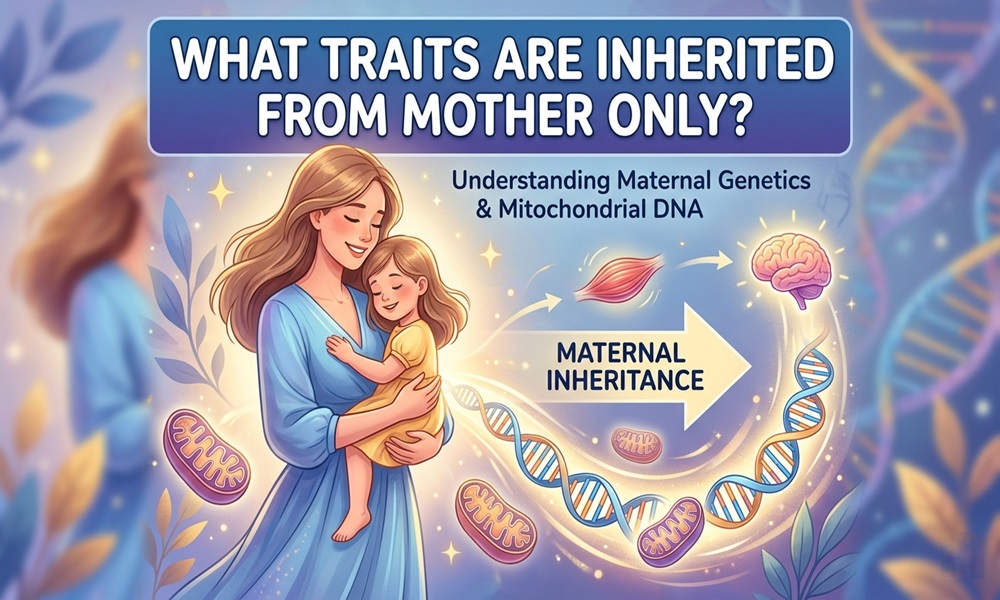
This is the big one. Mitochondria — the energy-producing organelles in your cells — have their own DNA, separate from the DNA in your cell’s nucleus. This mitochondrial DNA is inherited entirely from your mother, because sperm cells shed their mitochondria before fertilization.
Mitochondrial DNA is used by genealogists to trace your direct maternal line back thousands of years. It’s also used in forensic science and medical diagnosis, since mutations in mtDNA can cause rare but serious diseases like Leigh syndrome.
2. X-Linked Traits (Especially in Sons)
Sons receive their only X chromosome from their mother. This means X-linked traits — including certain forms of color blindness, hemophilia, and some immune conditions — come directly from the maternal line.
⚠️ Example: If a mother carries the gene for red-green color blindness on one of her X chromosomes, each of her sons has a 50% chance of inheriting it and being color blind. Her daughters, having two X chromosomes, are more likely to just become carriers.
Traits Inherited From the Father Only
1. The Y Chromosome
Fathers pass the Y chromosome exclusively to their sons. The Y chromosome carries the SRY gene that triggers male development in the womb, along with genes that influence sperm production and certain physical traits.
Like mitochondrial DNA, the Y chromosome is used to trace direct paternal lineages in genealogy research.
2. Paternal Imprinting
Some genes are “imprinted,” meaning only the copy from dad is active (and the copy from mom is silenced). This is a genetic phenomenon called genomic imprinting. Certain growth-related genes follow this pattern, which is why the paternal genome plays a larger role in placenta development and early fetal growth.
What About Intelligence? The Mother–Son Connection
One of the most widely shared claims in pop-genetics is that intelligence comes from the mother. Is it true?
Partially. Several genes associated with cognitive function are located on the X chromosome. Since sons only have one X — and it comes from mom — those genes have outsized influence on a son’s cognitive development compared to a daughter’s (who has an X from both parents).
But it’s not the whole story. Intelligence is polygenic, meaning it’s shaped by hundreds of genes spread across all chromosomes. Both parents contribute meaningfully. Environment, nutrition, education, and early childhood experiences also play enormous roles.
💡 Bottom line: A son may be slightly more reliant on mom’s X-linked genes for certain cognitive functions, but calling intelligence purely “from the mother” is an oversimplification.
Quick Breakdown: What Each Parent Most Influences
From Mother
- All mitochondrial DNA
- X-linked traits (color blindness, hemophilia)
- Male pattern baldness gene (AR gene on X chromosome)
- Certain cognitive gene expressions (in sons)
- Dental structure tendencies
- Immune function base
From Father
- Y chromosome (sons only)
- Facial bone structure dominance
- Paternal imprinted growth genes
- Some cardiovascular risk markers
- Certain temperament predispositions
- Sperm-related fertility traits (passed to sons)
Beyond DNA: Epigenetics and What It Changes
Here’s a twist most people don’t know: which genes you inherit matters less than whether those genes are switched on or off. This is called epigenetics.
Your environment — diet, stress, toxin exposure, even your parents’ and grandparents’ life experiences — can place chemical “tags” on DNA that affect how genes express themselves. These tags can be inherited across generations.
For example, research has shown that a grandfather’s diet can influence a grandson’s risk of metabolic disease, even though no change in DNA sequence occurred. This means genetic inheritance is more fluid and complex than a simple “mom gave me this, dad gave me that” framework.
Key Takeaways
- You inherit 23 chromosomes from each parent — a true 50/50 split at the chromosome level.
- Mitochondrial DNA comes 100% from your mother, with no paternal input whatsoever.
- Sons rely on mom’s single X chromosome for X-linked traits like color blindness and certain cognitive genes.
- Fathers exclusively pass the Y chromosome to sons, encoding male sex development and paternal lineage.
- Most visible traits — height, skin tone, eye color — are polygenic and influenced by both parents.
- Epigenetics means your environment can change which inherited genes are actually expressed.
- Male pattern baldness is primarily linked to an X-chromosome gene — so yes, you can “blame” mom’s side.
